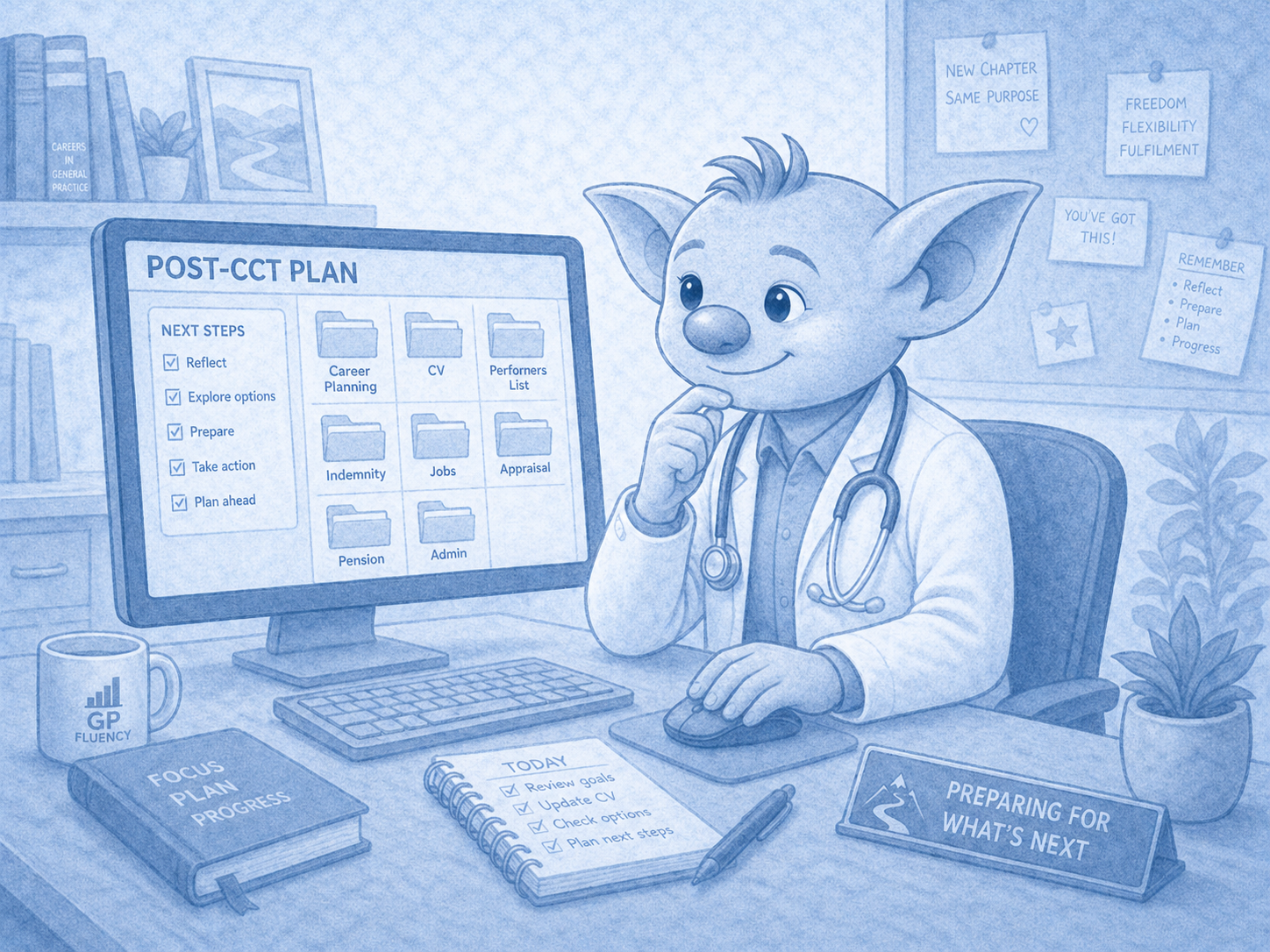
First 5 /Next 5
CCT To Do Framework for Completing GP Trainees
Getting your CCT is a huge milestone — but the final step from GP registrar to GP performer involves a few practical, regulatory and professional tasks. Some can be prepared before your final ARCP, while others depend on CCT confirmation and GP Register entry.
This checklist is split into two parts:
First 5 — the core steps that allow you to work safely and legally after CCT.
Next 5 — the professional-life essentials that make the first months after CCT smoother.
We have focused on the areas that most commonly create stress around CCT and early post-CCT work. It is not intended to replace official guidance, and individual circumstances vary. Use it as a prompt for what to check, then confirm the details with the relevant organisation for your own situation.
First 5: The core post- CCT steps:
-
You cannot work as a GP until your name appears on the GMC GP Register.
Your CCT confirms that you have completed an approved UK training programme and are eligible for entry onto the GP Register. The GMC describes the CCT application as the route for doctors who have completed approved training and want to join the Specialist or GP Register.
Check GMC Online, make sure your contact details are correct, complete your CCT application when invited, and confirm your GP Register entry before starting post-CCT GP work.
-
For trainees working in England, the Performers List is often one of the most stressful parts of the transition.
You are already on the Performers List as a GP registrar, but after CCT you need to change your performer type to GP Performer. PCSE’s current guidance says GP registrars completing training should log into PCSE Online, click Performers List, then Performer Type, and follow the steps to change status to GP Performer.
Check your personal details, performer type and employment details. If you are working outside England, check the equivalent arrangements for your nation or local area.
-
Your trainee indemnity or medical defence arrangements may not be appropriate for post-CCT work.
In England, NHS Resolution’s Clinical Negligence Scheme for General Practice covers clinical negligence liabilities arising from NHS general practice work for incidents from 1 April 2019. However, this does not replace wider medical defence support for issues such as GMC investigations, complaints, disciplinary matters, coroner’s court, private work, or work outside the scope of NHS general practice.
Contact your defence organisation before your CCT date and explain exactly what work you expect to do: salaried GP, locum sessions, urgent care, out-of-hours, portfolio work, private work, or a mixture.
-
After CCT, your RCGP status usually changes from Associate in Training to Member and your fees or membership category may change.
Log on on the RCGP website to check your membership status, contact details and subscription arrangements. RCGP states that membership is an annual subscription and renewal notices include the amount due and payment details.
If you are expecting formal confirmation, an MRCGP certificate, or need evidence for future employers, keep a copy somewhere safe.
-
Your first post-CCT role brings a different kind of admin from training.
If you are taking a salaried role, check your contract, sessions, workload expectations, induction, CPD, leave, pension, supervision or support arrangements, and how admin/results/tasks are handled.
If you are locuming, clarify what the session actually includes. “Locum session” can mean routine appointments, urgent triage, duty doctor, visits, admin, results, care home work, or a combination. Also check payment terms, cancellation arrangements, DBS requirements, pension forms, invoices and tax records.
For locum work, clarify the type of session, payment terms, cancellation arrangements, admin expectations, pension position and tax records.
Next 5: Professional life essentials
-
The move from trainee to qualified GP can change your tax, pension and income arrangements.
Check your tax code when you change employer, keep records of professional expenses, and understand how your NHS Pension contributions will be managed. If you are locuming in England, PCSE says Locum A and B forms can be submitted through PCSE Online.
If you are doing regular locum work, consider Self Assessment, expenses, invoicing and accountant advice. It is also worth reviewing income protection, as sick pay arrangements may change after training.
-
After CCT, you may lose trainee access to some resources and need to decide what you want to keep.
Check clinical update subscriptions, local guideline access, formulary access, Red Whale, NB Medical, NICE CKS, TeamNet, Accurx, Ardens, Clarity, FourteenFish and any tools used by your new practice.
This is also a good time to check what your employer provides and what you are paying for yourself.
-
After CCT, you move from the training portfolio and ARCP cycle into the qualified GP appraisal and revalidation cycle.
RCGP guidance says your Responsible Officer will set the date of your first appraisal, which you can expect within the appraisal year following your ARCP revalidation, and that it is your professional responsibility to make sure you are offered an appraisal in your first year.
Choose or continue with an appraisal toolkit and start collecting proportionate evidence from the beginning: CPD, reflections, significant events, complaints, compliments, feedback and quality improvement.
-
Small pieces of admin can cause disproportionate stress after CCT.
Check your BMA status, DBS certificate, DBS Update Service, safeguarding certificates, BLS/AED, occupational health evidence, immunisation record and hepatitis B titre.
The DBS Update Service currently costs £16 per year and allows a certificate to be kept up to date and taken from role to role, provided the roles are in the same workforce and require the same level of check.
Also check Smartcard access, prescribing setup, local logins, payroll forms, ID badges, parking and first-day contacts.
-
Before leaving your training practice, make use of the fact that your supervisors and admin team still know you well.
Save key evidence, download important portfolio documents, confirm referee details, ask for references if needed, and check whether you need copies of certificates, QI evidence, teaching evidence or mandatory training records.
It is also worth having a final transition conversation with your supervisor: what kind of first role might suit you, what support you may need, and what to be cautious about in your first few months as a qualified GP.
For more detail, including practical prompts, various reminders links and CCT folder checklist, download the full guide: