The GP Inbox
Clinical decisions beyond the consultation
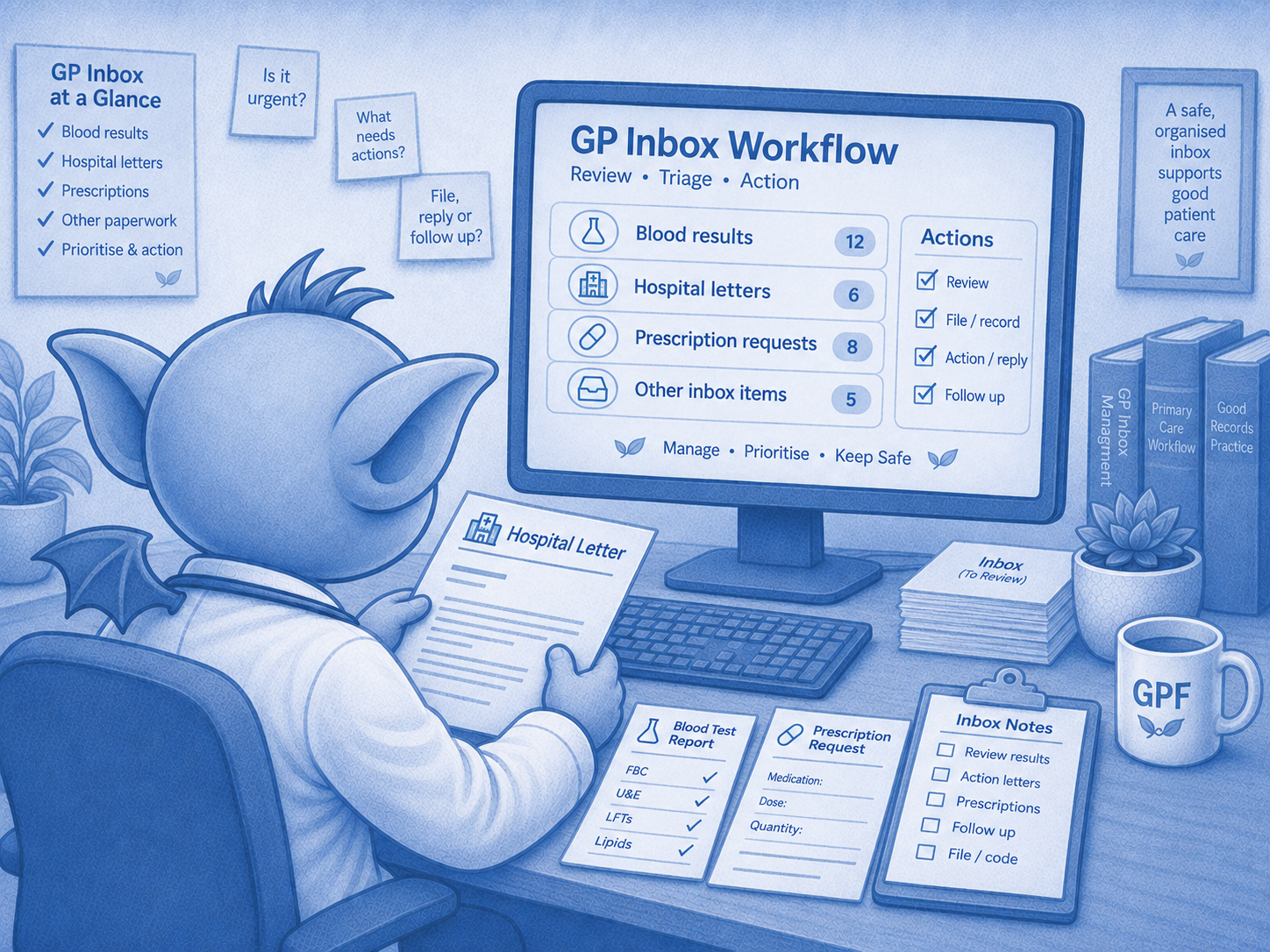
In general practice, clinical decisions don't stop when the patient leaves the room. Blood results, hospital correspondence, specialist recommendations and prescribing requests all require interpretation, judgement and action.
The GP Inbox is a growing collection of short, practical decision cards designed to help GP trainees develop their clinical reasoning in everyday primary care.
Choose a clinical theme, read the inbox item and decide what you would do before turning the card.
Each three-sided card takes you through:
The inbox item — a realistic clinical scenario requiring a decision.
Suggested action — a practical approach to managing the situation.
Essential learning — the underlying reasoning and links to relevant guidance.
Use the cards for independent learning or as discussion prompts in tutorials. Remember that clinical decisions may depend on individual circumstances and local pathways.
Haematology
Four decisions from the GP inbox
An unexpected platelet count, a raised ferritin, a DVT discharge letter and a repeat anticoagulant prescription.
These four scenarios explore different aspects of clinical judgement: recognising when to investigate, when a proportionate approach is appropriate, how to ensure safe follow-up and when an established prescription needs reviewing.
Read each scenario, commit to an action and turn the card to explore the suggested approach.
An unexpected raised ferritin
You're reviewing blood results requested for a 58-year-old man who attended with fatigue.
He is otherwise well, with no recent acute illness documented.
Blood results:
Ferritin: 720 µg/L
Transferrin saturation: 28%
Haemoglobin: 149 g/L
His medical history includes type 2 diabetes, with a recorded BMI of 31.
Liver function and inflammatory markers have not yet been checked.
How would you action this result?
Commit to your decision, then click to turn.
An unexpected raised platelet count
A 62-year-old man recently attended with fatigue. History and examination revealed no obvious cause. No recent infection or inflammatory illness was reported.
FBC:
Platelets: 518 × 10⁹/L
Hb: 142 g/L
WCC: 7.0 × 10⁹/L
Platelets eleven months ago: 284 × 10⁹/L.
How would you action this result?
Commit to your decision, then click to turn.
A DVT discharge letter
A 64-year-old woman has been diagnosed with a left popliteal DVT, four weeks after knee replacement surgery.
She has no previous history of VTE.
The discharge letter confirms that apixaban has been started. Initial dosing is documented and 14 days' treatment supplied.
Action for GP:
"GP to continue anticoagulation."
No treatment duration, review arrangements or responsible clinician are specified.
How would you action this letter?
Commit to your decision, then click to turn.
A DOAC repeat prescription
A 78-year-old woman requests her repeat apixaban 5 mg twice daily, started eight weeks ago following a pulmonary embolism.
She has known chronic kidney disease.
Recent blood results:
Six months ago:
Creatinine: 123 µmol/L
eGFR: 39 mL/min/1.73m²
Current:
Creatinine: 125 µmol/L
eGFR: 38 mL/min/1.73m²
Weight: 54 kg.
Recorded CrCl: 28 mL/min.
The repeat prescription has been flagged for renal-function review.
How would you action this prescription request?
Commit to your decision, then click to turn.