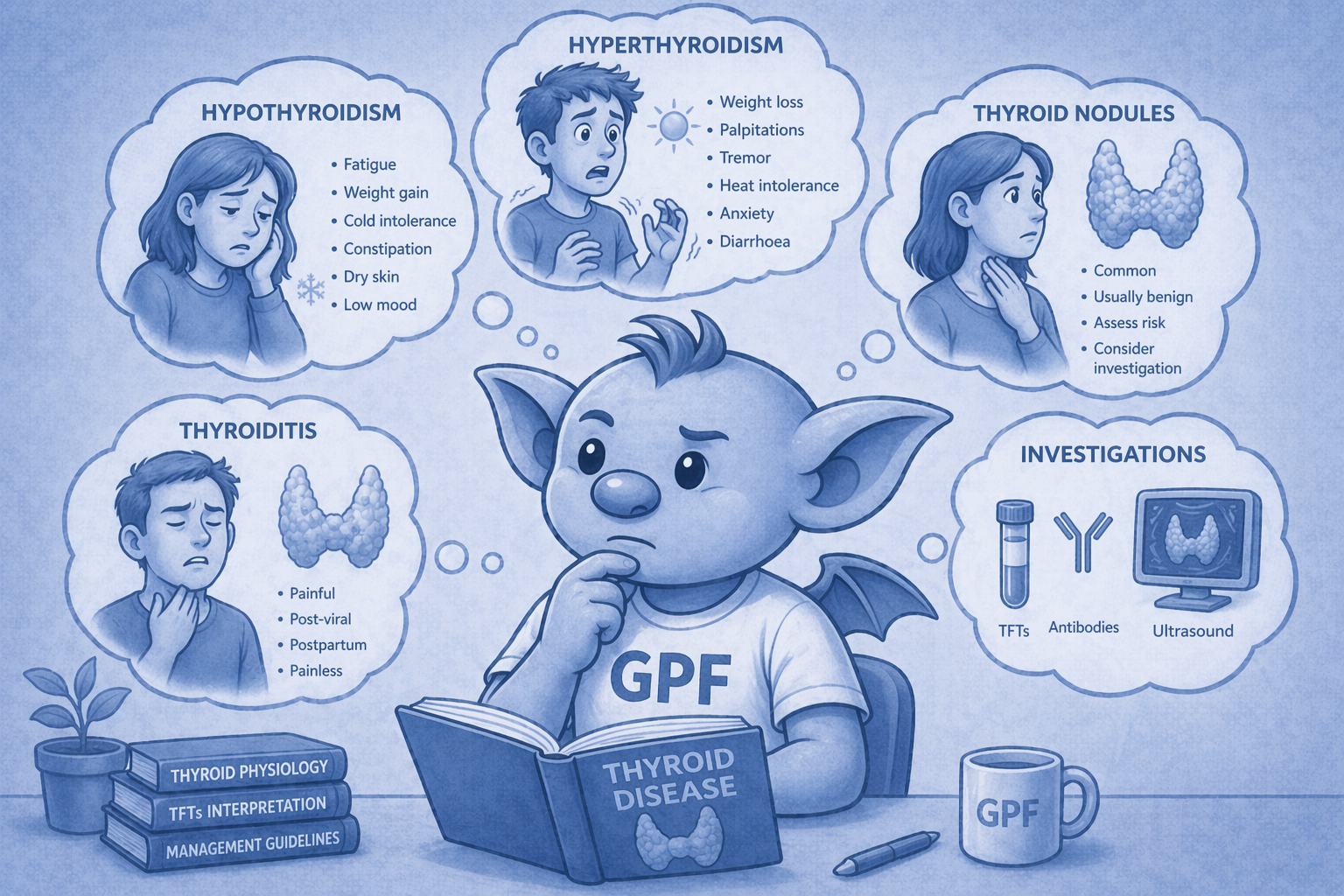
Thyroid Disease
Thyroid problems are common in primary care, but for GP trainees the challenge is rarely memorising endocrine detail. More often, the real task is recognising when thyroid disease is plausible, interpreting thyroid function tests sensibly, managing common presentations safely, and explaining decisions clearly in everyday GP, the SCA and the AKT. NICE guidance covers investigation of suspected thyroid disease and management of primary thyroid disease, while excluding thyroid cancer and thyroid disease in pregnancy.
This resource focuses on practical interpretation, next steps, safe management, and clear communication. It has been designed to help trainees think clearly about thyroid disease rather than simply collect facts.
Making Sense of TFTs in General Practice
A simple framework for GP trainees reviewing thyroid function tests in everyday practice
Introduction
Thyroid function tests are common in general practice, but they can feel harder to interpret than they should. For GP trainees, the challenge is usually not memorising endocrine detail. It is knowing when a result is straightforward, when it needs a second look, and what the next step should be in primary care.
This resource is designed to simplify that first-pass thinking. It focuses on the thyroid blood test patterns most commonly seen in GP, the situations that can mislead you, and the practical question that matters most when reviewing results: what do I do next?
Why trainees find TFTs tricky
TFTs can feel confusing because symptoms are often non-specific, mild abnormalities are common, and the blood results do not always match the story neatly. NICE notes that thyroid dysfunction should not usually be inferred from a single common symptom alone, and that thyroid tests can also be distorted during acute non-thyroid illness.
In practice, the difficulty is rarely recognising a very abnormal result. It is deciding what to do with the incidental, borderline or slightly unexpected one.
Hypothyroidism in General Practice: Through Cases
This is a practical self-directed learning resource for GP trainees.
Using four GP cases and their TFTs results
It explores hypothyroidism as it is actually encountered in training and everyday primary care
Almost incidental blood-test findings
Monitoring on amiodarone
Subclinical biochemical results
Levothyroxine review.
The focus throughout is on making sense of TFTs, recognising common patterns, interpreting results in context, and making safe, proportionate management decisions in general practice.
-
What is it?
Hashimoto’s thyroiditis is the commonest cause of primary hypothyroidism in the UK. It is an autoimmune condition in which gradual thyroid gland damage leads to reduced thyroid hormone production. NICE describes primary hypothyroidism as commonly autoimmune in origin, and CKS identifies Hashimoto’s thyroiditis as the most common cause in iodine-sufficient areas such as the UK.Typical patient
Often a woman, with risk increasing with age. Presentation is often gradual and non-specific rather than dramatic. Some patients have a painless goitre, but many simply present with tiredness, constipation, dry skin, weight gain, or an incidental abnormal TFT pattern.How does it differ clinically?
Unlike subacute thyroiditis, the gland is usually not painful or tender. Unlike post-treatment or drug-induced hypothyroidism, there may be no obvious external trigger. Antibody testing can help identify autoimmune thyroid disease, although in routine primary care it often does not change day-to-day treatment once overt hypothyroidism is confirmed.Management
In primary care, the key task is to recognise the pattern of high TSH with low FT4, start levothyroxine where appropriate, and monitor response over time. The RCGP curriculum expects GPs to diagnose and manage common thyroid disorders as part of everyday general practice. -
What is it?
Hypothyroidism may develop after treatment for previous thyroid disease, especially after thyroid surgery or radioactive iodine. In these cases, the diagnosis is usually not mysterious — the key GP role is recognising the expected consequence, replacing thyroid hormone, and monitoring safely. NICE’s thyroid guideline sits within primary thyroid disease management, and post-treatment hypothyroidism is a well-recognised cause in UK practice.Typical patient
Think of a patient with a history of thyroidectomy or radioiodine, often already known to hospital services or on long-term thyroid replacement. The GP may first encounter this through routine monitoring, dose review, or symptoms suggesting under- or over-replacement.How does it differ clinically?
The clue is usually in the past history rather than the examination. Unlike Hashimoto’s, the cause is typically already known or strongly suggested. The main clinical question in GP is often not “what is the diagnosis?” but “is the replacement dose right?”Management
Long-term levothyroxine replacement with regular TFT monitoring. NICE recommends TSH monitoring after treatment initiation or dose change, then annual monitoring once stable. -
What is it?
Some medicines can cause hypothyroidism. In everyday UK general practice, the most important examples are amiodarone and lithium. CKS recognises both as important drug causes of hypothyroidism.Typical patient
Think about this in a patient taking amiodarone for arrhythmia or lithium for bipolar disorder, especially when abnormal thyroid results appear on monitoring or symptoms develop gradually over time. The diagnosis may emerge through routine surveillance rather than first presentation with symptoms.How does it differ clinically?
The clue is the medication history. In amiodarone-associated hypothyroidism especially, serial TFTs may show progression from normal thyroid function to a subclinical pattern and then overt hypothyroidism. This differs from Hashimoto’s, where there is no drug trigger, and from post-treatment hypothyroidism, where the trigger is prior thyroid intervention.Management
Recognise the TFT pattern, review the patient clinically, and manage hypothyroidism appropriately — often with levothyroxine — while making sure responsibilities are clear between GP, specialist teams and monitoring pathways. In drug-induced cases, the important question is not only “is this hypothyroidism?” but also “what is the safest wider plan around the causative medication?”
Hyperthyroidism /Thyrotoxicosis in Primary Care
This can be harder to recognise than trainees expect.
Some patients present with classic symptoms such as palpitations, tremor and weight loss, but others present less obviously — with anxiety-type symptoms, new atrial fibrillation, or general systemic upset.
In general practice, the challenge is not just spotting the pattern, but recognising urgency, starting sensible early management, and making sure referral and follow-up are clear.
This practical resource is designed for GP trainees and focuses on the primary care role: recognising possible hyperthyroidism, interpreting common thyroid function test patterns, identifying red flags, offering early symptom control where appropriate, and understanding when specialist discussion or referral is needed.
-
What is it?
Graves’ disease is the commonest cause of hyperthyroidism in the UK. It is an autoimmune condition in which thyroid-stimulating antibodies drive excess thyroid hormone production.Typical patients
Often a younger or middle-aged adult with a diffuse smooth goitre. Eye signs or orbitopathy are strongly suggestive when present. Some patients present quite classically with tremor, palpitations and weight loss; others are less clear-cut.How does it differ clinically?
Compared with toxic nodular disease, Graves’ is more likely to involve a smooth diffuse gland rather than nodules, and more likely to have eye involvement. TRAb can help confirm the diagnosis and may support referral triage if this fits local pathways.Management
Usually referred for specialist-led treatment. Definitive management may involve antithyroid drugs, radioactive iodine or surgery, depending on the patient, the cause, and the wider clinical picture. -
What is it?
Toxic multinodular goitre is hyperthyroidism caused by multiple autonomous thyroid nodules. It is an important cause of thyrotoxicosis in primary care, especially in older adults.Typical patient
More often an older adult with a nodular, non-tender thyroid gland. Presentation may be less dramatic than trainees expect — for example weight loss, atrial fibrillation or a more “apathetic” hyperthyroid picture rather than obvious tremor and agitation.How does it differ clinically?
Unlike Graves’ disease, the gland is usually nodular rather than smooth, and eye signs are not a typical feature. It is also much less likely to go into remission spontaneously.Management
Usually referred for specialist assessment. Because toxic multinodular goitre is unlikely to remit, definitive treatment is often needed. NICE recommends radioactive iodine as first-line definitive treatment for many adults if suitable. -
What is it?
A toxic adenoma is a single autonomous thyroid nodule producing excess thyroid hormone.Typical patient
Think of a patient with biochemical thyrotoxicosis and a solitary, non-tender thyroid nodule rather than a diffuse goitre.How does it differ clinically?
The key clue is that the excess hormone is coming from one dominant overactive nodule, rather than diffuse autoimmune stimulation or multiple nodules.Management
Usually referred for specialist management. NICE recommends radioactive iodine or hemithyroidectomy as first-line definitive treatment options for many adults, depending on the clinical situation. -
What is it?
Subacute thyroiditis is an inflammatory thyroid condition, often following a viral illness. It can cause a transient thyrotoxic phase, but this is thyrotoxicosis without true hyperthyroidism.Typical patient
Often a patient with a recent viral illness, fever, and a painful or tender thyroid. ESR or CRP may be raised.How does it differ clinically?
This is the important differentiator: the thyroid is painful / tender. That should push you away from Graves’ disease or toxic nodular disease, which are usually non-tender.Management
Antithyroid drugs such as carbimazole do not work, because hormone is being released from an inflamed gland, not overproduced. Management is usually supportive, for example NSAIDs and sometimes beta-blockers for symptom control. -
What is it?
Thyroid storm is a rare endocrine emergency caused by severe thyrotoxicosis with systemic decompensation.Typical patient
Do not think “routine abnormal TFTs.” Think severe systemic illness: fever, marked tachycardia, agitation, delirium, cardiovascular instability, or collapse.How does it differ clinically?
This is not simply “bad hyperthyroidism.” The distinguishing feature is the degree of acute systemic illness.Management
This needs emergency assessment and hospital management, not routine referral.
Medications in Thyroid Disease
This is quick-reference resource for GP trainees.
It focuses on the medicines most relevant to day-to-day primary care — including levothyroxine, propranolol, carbimazole and supportive treatment in thyroiditis — with an emphasis on what each is used for, what GPs need to know, and the key safety points to remember.
Designed as a concise doctor-facing guide, it supports safer prescribing, clearer monitoring, and more confident management of thyroid disease in general practice.
Thyroid Disease in RCGP Assessments:
AKT-Style Questions is a practical revision resource for GP trainees, using five single-best-answer questions to explore how thyroid disease is tested in the RCGP AKT.
The AKT is designed to assess applied knowledge for independent UK general practice, so thyroid questions are more likely to focus on recognition of common patterns, interpretation of TFTs, safe prescribing, urgency, and guideline-based management than on rare endocrine detail.
This resource includes AKT-style questions, answers and explanations to help trainees think in the way the exam expects.
In the AKT, thyroid disease is usually tested through decisions a GP would actually need to make — what pattern is this, what does it mean, what is the next best step, and what is the safest management in UK primary care?
The RCGP states that the AKT tests applied knowledge for independent practice and remains predominantly clinical in focus.
Thyroid Disease: SCA Cases
These three cases use thyroid disease as it is more likely to appear in the exam: not as isolated endocrine knowledge, but as a test of whether the candidate can recognise common patterns, interpret thyroid blood tests, explain findings clearly, make a safe GP-centred plan, and negotiate appropriate follow-up or referral.
The cases are built around realistic primary care presentations: an unexpected new diagnosis of hypothyroidism after cholesterol review, symptoms with only a subclinical result, and possible thyrotoxicosis presenting as “anxiety” or palpitations. Together, they reflect the way thyroid disease can test all three SCA domains — focused data gathering and interpretation, clear patient-centred explanation, and proportionate clinical management under time pressure.